
“I will give men as the price for fire an evil thing in which they may all be glad of heart while they embrace their own destruction.”
— Hesiod, Works & Days
You have probably heard a version of the myth of Pandora. In the popular version, Pandora opened a box containing all the ills and curses of life, letting them out into the world, and at the bottom of the box was hope.
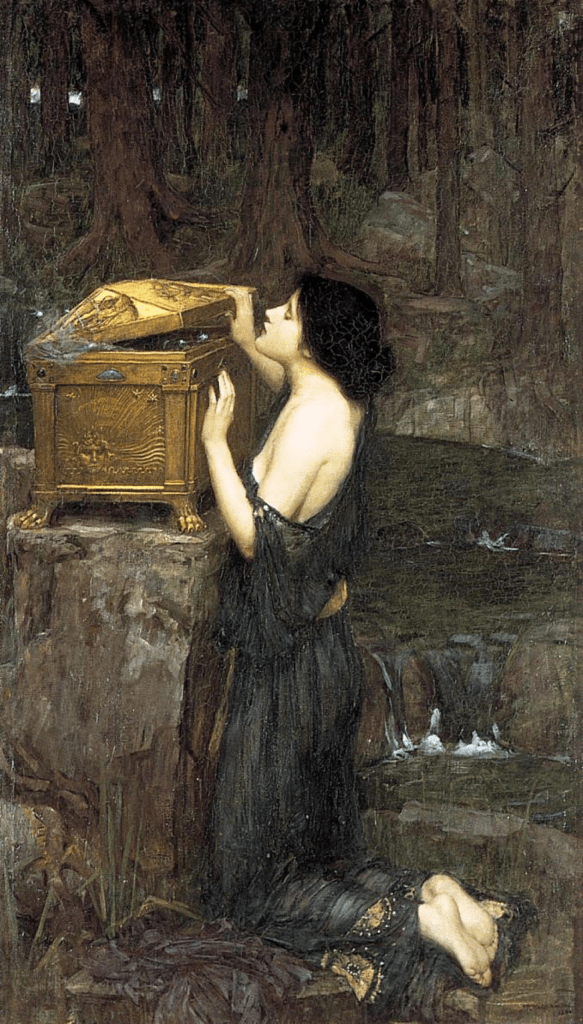
If this sounds a lot like story of Eve in the Garden of Eden, it’s not a coincidence. Men have been blaming women for everything that’s wrong in the world for millennia.
But there’s a lot more to the story that you probably haven’t heard. I’m going to tell it in good Unitarian fashion, that is overly complexified, with some Greek etymologies, some sexual innuendo, and a little for anthropology thrown in, for fun.
The myth of Pandora is tied up with another myth, the myth of Prometheus. Prometheus saw that mortals were making sacrifices to the gods and burning whole animals and going hungry as a result. So he convinced Zeus to accept just part of the sacrifice and leave the rest for mortals to eat. This was the first separation of the sacred from the profane.
Zeus got to choose which part he wanted though, so Prometheus in his craftiness (the Greeks loved craftiness in their heroes) Prometheus made one pile with the meat and another with the bones, but he covered the meat with the hide of the animal and he covered the bones with fat. So when Zeus came along, the pile of bones covered with fat looked more appealing, and so Zeus chose that, leaving the meat to the mortals.
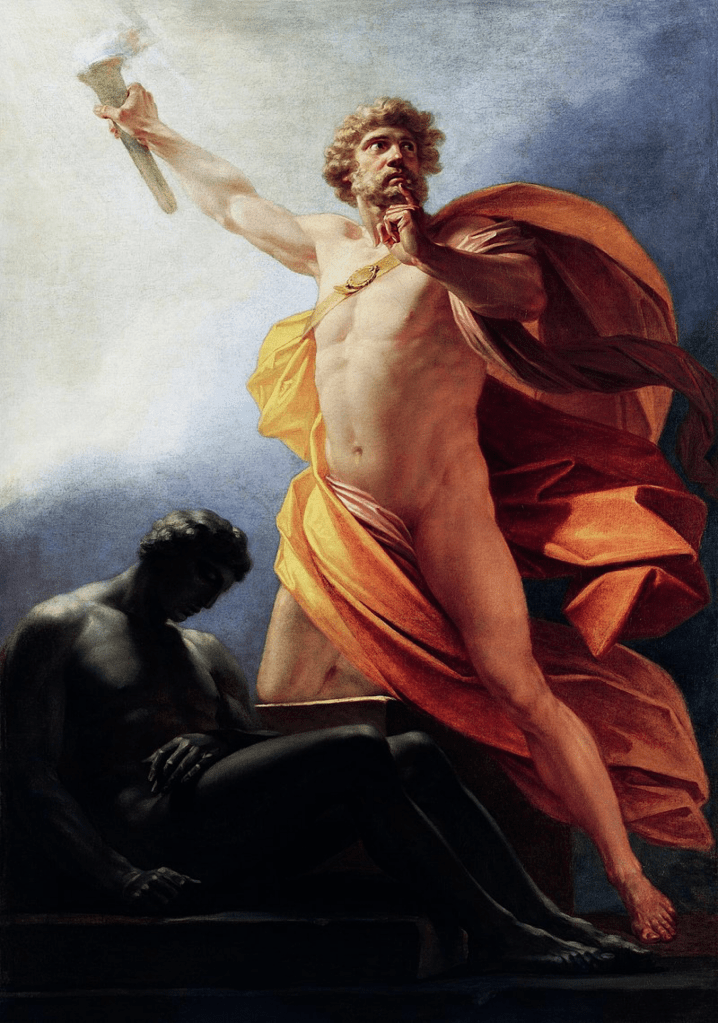
When Zeus realized he had been tricked, he was angry and took fire away from humans as punishment. But Prometheus stole it back, carrying it in a hollow stalk so it would not be extinguished. Note that humans already had fire when Zeus took it away, and Prometheus stole it back. This tracks the likely history of the domestication of fire, which probably began with human’s noticing the fire caused by lightning strikes. Lighting was a manifestation of Zeus, so fire was his to give and to take away. Prometheus’ gift, then, was the knowledge of how to keep fire alive, specifically how to transport embers from one place to another without extinguishing them.
And with the knowledge of keeping fire alive, Prometheus brought all the arts and sciences, which would never have been possible in the absence of fire. Prometheus brought the tools of civilization to humankind. Ever since, Prometheus has been a symbol of human progress. One more thing Prometheus gave to humankind was the gift of prophecy, the means of discerning the future. Not coincidentally the name Prometheus means “forethought”.
When Zeus learned that Prometheus had stolen the fire back, he cursed both Prometheus and humankind. Prometheus, he chained to a rock. As for humankind, he came up with his own crafty curse. He said, “I will give men as the price for fire an evil thing in which they may all be glad of heart while they embrace their own destruction.” He then created “Pandora,” whose name means the “all-gifted.” Pandora, was given as a bride to the brother of Prometheus, Epimetheus, whose name means “afterthought.”
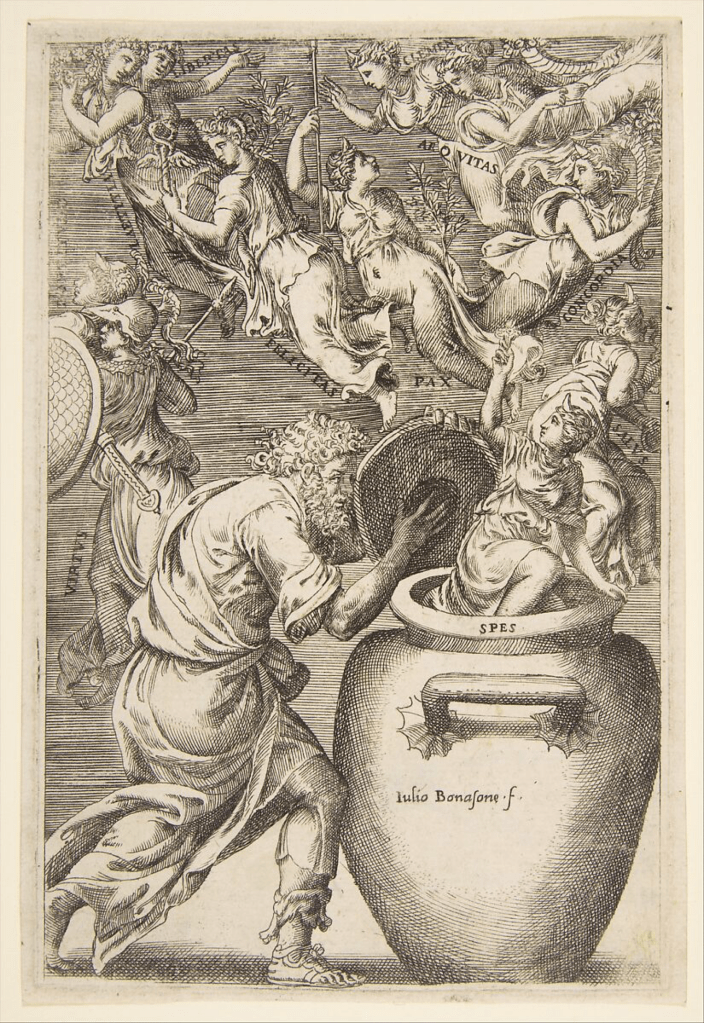
Prometheus warned his brother Epimetheus not to accept any gifts from Zeus, but Epithemeus (because of his name) ignored his brother’s advice. In Zeus’ palace, there were two jars, one filled with evil gifts and the other with good ones. As a wedding gift, Zeus gave the couple one of the jars (in later retellings, it became a box). Pandora then opened the jar. (In some versions, it was Epithemeus who opened Pandora’s jar—probably a sexual allusion.) All the ills and sorrows of mortal life were let loose on the world. And the last thing in the jar was hope.
What was hope doing in the jar with all the curses? Zeus said that the gift of fire came with a price. A lot of people have misunderstood this story, believing Pandora or womankind was the curse. The poet Aeschylus explained that, when Prometheus was chained to the rock, humankind ceased foreseeing their doom and cause blind hopes to dwell in their breasts. Humankind lost the gift of foresight and “hindsight” and the ambiguously named Pandora (all gifts).
“I caused mortals to cease foreseeing their doom…. I caused blind hopes to dwell within their breasts.”
— Aeschylus, Prometheus Bound
Hope was in the jar, not because it was a blessing, but because it was another one of Zeus’ curses. But unlike the other curses, human beings embraced this one. Hope is a curse because it keeps us from foreseeing our doom. It is what keeps us chained to our fate, as surely as Prometheus was chained to the rock. The moral of the story is that when trade foresight for hope, we end up embracing our own destruction.
 Another End of the World is Possible